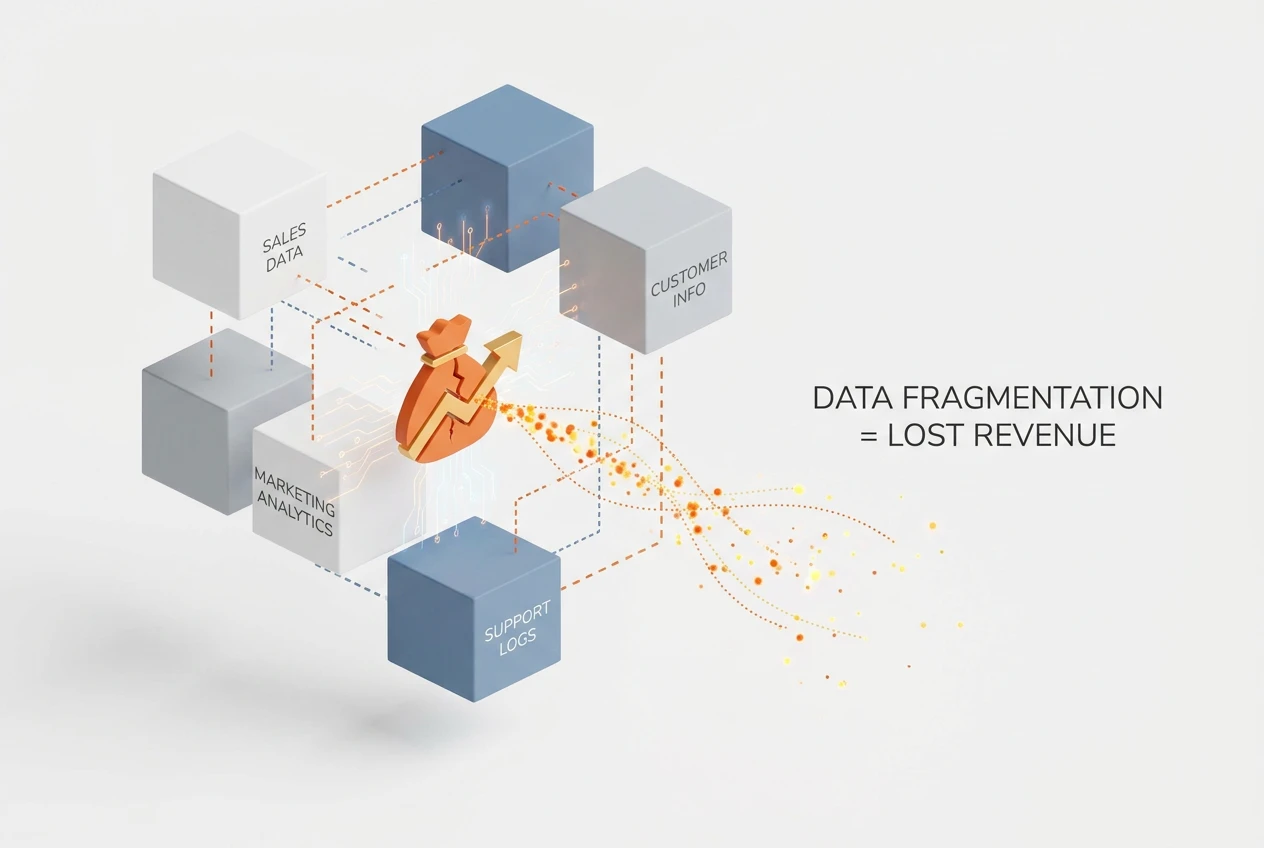
A disconnected CRM is a silent revenue killer because it creates data silos, leading to missed follow-ups, inaccurate forecasting, and poor customer experiences. This fragmentation breaks the lead-to-cash cycle. Consequently, it directly reduces sales efficiency and causes significant sales revenue loss. This happens by failing to capitalize on opportunities hidden across different applications. Your team works hard, but their tools are working against them.
What Exactly Are CRM Data Silos?
CRM data silos are isolated pockets of information. They occur when different departments or even different apps use separate, non-communicating systems. For example, your marketing team might use one platform for lead generation. Meanwhile, your sales team uses a separate CRM for tracking deals. The data does not flow freely between them. Therefore, this creates a fragmented view of the customer journey, making a complete picture impossible to see.
How Does a Disconnected CRM Affect Sales Efficiency?
A disconnected CRM severely damages sales efficiency. Sales reps waste valuable time manually entering data into multiple systems. Furthermore, they struggle to find accurate, up-to-date information about a lead’s history. This leads to redundant work and delayed follow-ups. Instead of selling, your team spends its time on administrative tasks. Ultimately, this constant friction slows down the entire sales process and reduces the number of deals they can close.
What is the Impact on the Lead-to-Cash Cycle?
The lead-to-cash cycle is the entire process from capturing a new lead to receiving payment. A disconnected CRM breaks this cycle at multiple points. For instance, lead handoffs from marketing to sales are often slow and incomplete. Quoting and invoicing might happen in yet another system, creating delays and errors. This fragmentation means opportunities fall through the cracks, and cash flow is negatively impacted. A smooth, automated cycle is essential for healthy revenue growth.
Why Do Multiple Sales Tools Cause These Problems?
Using multiple, specialized sales tools often creates more problems than it solves. Each application becomes its own data island. Consequently, you get conflicting information and no single source of truth. Your team has to learn, manage, and switch between several interfaces, which decreases focus and productivity. Notably, the cost of licensing and maintaining these separate tools adds up, creating a poor return on investment. This is a classic example of the problems with multiple sales tools.

How Does This Directly Cause Sales Revenue Loss?
Sales revenue loss is the most direct consequence of a disconnected CRM. When sales reps lack a full view of customer interactions, they miss cross-sell and upsell opportunities. Furthermore, inaccurate data leads to flawed sales forecasting and poor strategic decisions. Potential customers receive inconsistent messaging, which damages trust and leads them to competitors. In short, every data gap and every manual process is a potential point of failure where revenue leaks out of your business.
What Are the Common Signs of a Disconnected CRM?
Identifying a disconnected CRM is crucial for stopping revenue loss. Your organization might be suffering if you notice several key indicators. It is important to recognize these symptoms before they cause more damage. For example, constant complaints about data quality are a major red flag. Here are some common signs to watch for:
- Sales and marketing teams argue about lead quality and data accuracy.
- Reps complain about spending too much time on manual data entry.
- It is difficult to generate a single report showing the entire customer journey.
- Customers mention having to repeat their history to different team members.
- Your sales forecasts are consistently inaccurate.
- The sales cycle seems unusually long or full of bottlenecks.
How Can You Fix CRM Data Silos?
Fixing CRM data silos requires a fundamental shift away from fragmented tools. The solution is not to buy another integration app that patches the problem. Instead, the most effective strategy is to adopt a unified platform. A system where all business functions, from marketing and sales to operations and finance, operate within a single ecosystem. This creates one source of truth for all data. BOOM ERP provides this unified environment, eliminating silos and streamlining the entire lead-to-cash cycle from end to end.
Why Is a Unified Ecosystem the Best Solution?
A unified ecosystem like BOOM ERP is superior to a collection of separate apps. It is designed from the ground up to ensure seamless data flow. This means your sales team always has a 360-degree view of every customer. Additionally, automation becomes simple and powerful, as workflows can cross departmental boundaries without friction. With one platform, you reduce training time, lower subscription costs, and significantly boost overall sales efficiency. It simplifies complexity and allows your team to focus on what truly matters: building relationships and closing deals.
Frequently Asked Questions
What is the biggest problem with a disconnected CRM?
The biggest problem is the creation of CRM data silos. These silos prevent a complete view of the customer, leading to missed opportunities, poor service, and significant sales revenue loss.
How does a disconnected system affect the lead-to-cash cycle?
It fragments the lead-to-cash cycle by creating bottlenecks. For example, manual data transfers between marketing, sales, and finance systems cause delays, errors, and lost deals, directly impacting cash flow.
Can small businesses be affected by CRM data silos?
Absolutely. In fact, small businesses can be even more vulnerable. They often lack the resources for complex integrations, making the negative impacts of a disconnected CRM on sales efficiency and growth even more pronounced.
Is buying more integration software the answer?
No, this is often a temporary fix that adds more complexity. The best long-term solution is a natively unified platform like BOOM ERP, which eliminates the need for fragile, third-party integrations.
How does a unified CRM improve sales forecasting?
A unified CRM provides a single source of truth. With complete and accurate data from the entire customer lifecycle, your sales forecasts become far more reliable, enabling better strategic planning.
Stop letting a disconnected CRM dictate your team’s potential and hurt your bottom line. A unified platform eliminates data silos and empowers your sales team to perform at its peak. BOOM ERP offers an end-to-end solution to streamline your entire lead-to-cash workflow. Discover how our features can transform your operations. Find out more by visiting our features page or connect with us on Facebook.