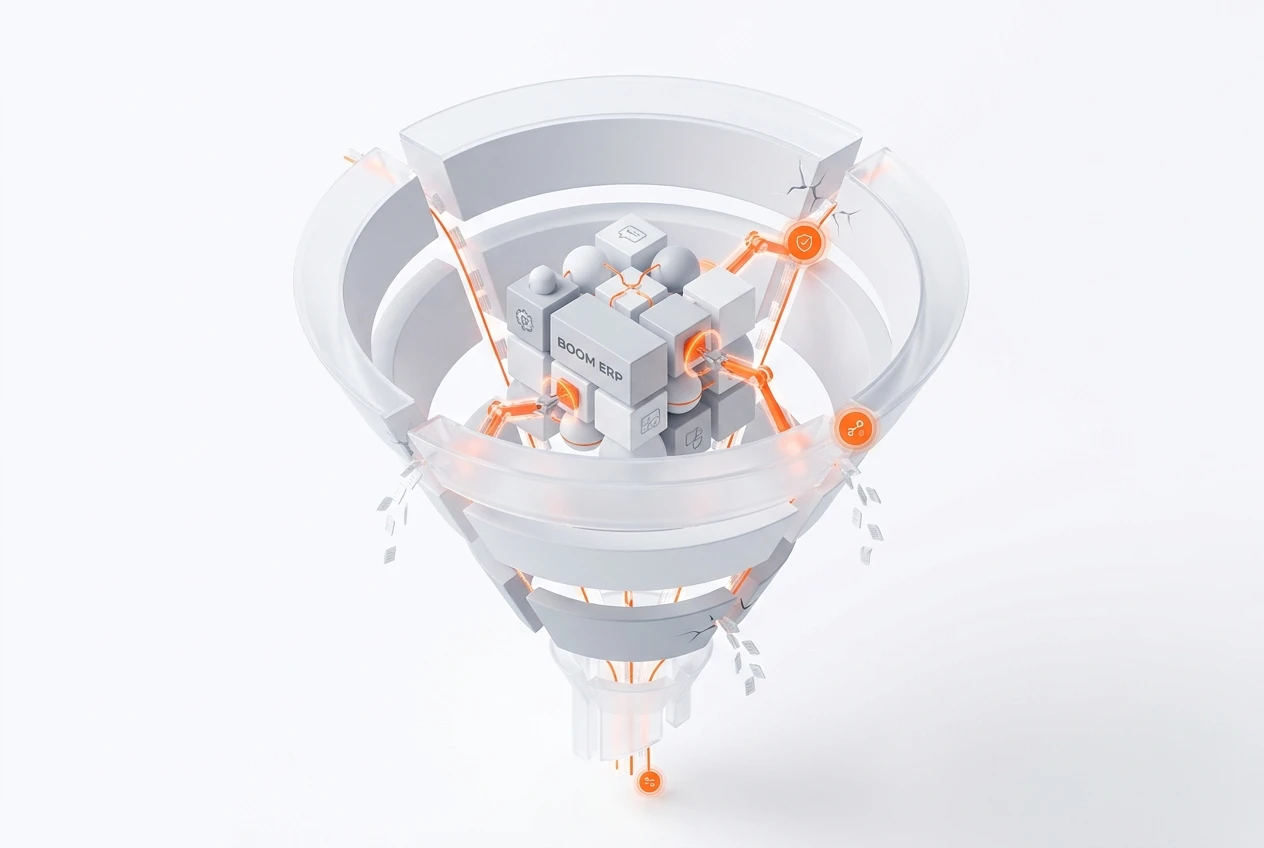
A unified CRM like BOOM ERP prevents revenue leaks by consolidating customer data, communication, and sales activities into one system. This eliminates data silos and missed follow-ups caused by switching between apps, ensuring every lead is tracked from initial contact to final sale. By plugging the gaps where potential income is lost, you secure your entire sales funnel. This single source of truth provides complete visibility, stopping revenue leakage before it starts.
Why Do Disconnected Tools Cause Sales Funnel Leaks?
Disconnected tools create data silos, which are the primary cause of sales funnel leaks. When your sales, marketing, and service teams use separate apps, critical customer information gets fragmented. A lead’s interaction history might live in three different places. This fragmentation leads to missed follow-ups, inconsistent messaging, and a poor customer experience. A unified CRM like BOOM ERP breaks down these silos, providing a 360-degree customer view and ensuring no lead falls through the cracks, preventing revenue leakage.
How Does a Unified CRM Improve Lead Tracking?
A unified CRM improves lead tracking by creating a single, unbroken timeline for every prospect. From the first website visit to the final invoice, every interaction is automatically logged in one place. This means sales reps have complete context for every call and email. For instance, they can see if a lead downloaded a whitepaper or spoke with support last week. This level of detail, managed within an all-in-one CRM, ensures timely and relevant follow-ups, increasing conversion rates by up to 30%.
Can a Single Platform Reduce Manual Data Entry Errors?
Yes, absolutely. A unified CRM dramatically reduces manual data entry and the costly errors that come with it. By automating data capture from forms, emails, and calls, the system ensures information is accurate and consistent. This frees up your sales team from tedious administrative tasks, allowing them to focus on selling. BOOM ERP’s end-to-end workflow automates data flow from lead to cash, minimizing human error and plugging a significant source of revenue leakage in your CRM sales pipeline.
What Role Does Automation Play in a Unified CRM?
Automation in a unified CRM is the engine that drives efficiency and prevents leads from going cold. It can automatically assign new leads to reps, send follow-up emails, and create tasks based on customer behavior. For example, if a prospect visits your pricing page, the system can trigger a notification for a sales rep to call them. This proactive engagement ensures no opportunity is missed. It’s a key strategy to stop losing leads in the sales process and secure revenue.
How Does Centralized Communication Stop Losing Leads?
Centralized communication stops leads from being lost by keeping every conversation in one place. Instead of searching through separate email inboxes, chat logs, and call notes, everything is attached to the customer’s profile in the CRM. This means any team member can pick up a conversation with full context. A unified platform for sales and marketing ensures a seamless handover from one department to another, providing a consistent experience for the customer and plugging communication gaps where revenue leaks.
What Are the Key Features of a Unified CRM for Sales?
A powerful unified CRM offers several features designed to optimize the sales process and prevent revenue leakage. These components work together to provide a seamless experience for both your team and your customers.
- 360-Degree Customer View: Consolidates all contact information, communication history, and sales activities into a single, easy-to-read profile.
- Sales Pipeline Management: Visualizes your entire sales funnel, allowing you to track deals at every stage and identify bottlenecks instantly.
- Automated Workflows: Automates repetitive tasks like lead assignment, email follow-ups, and data entry to improve efficiency.
- Integrated Communication Tools: Includes built-in email, phone, and chat functionalities to log all interactions automatically.
- Advanced Reporting & Analytics: Provides real-time dashboards to monitor key performance indicators (KPIs) and forecast revenue accurately.
- Role-Based Security: Ensures team members only see the data relevant to their roles, protecting sensitive information.
How Can a Unified CRM Improve Sales Forecasting Accuracy?
A unified CRM improves sales forecasting by basing predictions on complete and accurate data. Since all sales activities, deal stages, and communications are tracked in one system, your pipeline data is reliable. AI-powered analytics can then analyze historical trends and current deal momentum to generate forecasts with over 95% accuracy. This allows sales directors to make informed decisions, allocate resources effectively, and identify potential shortfalls long before they impact revenue, fixing a leaking sales funnel at its source.
Does an All-in-One CRM Help Align Sales and Marketing?
Yes, aligning sales and marketing is one of the greatest strengths of an all-in-one CRM. When both teams work from the same database, marketing can see which campaigns generate the highest quality leads, and sales can provide feedback on lead quality. This shared visibility fosters collaboration, creating a feedback loop that continually improves strategy. A unified platform for sales and marketing ensures a smooth handoff of marketing-qualified leads (MQLs) to the sales team, boosting conversion rates.
How Does BOOM ERP Provide a Unified Solution?
BOOM ERP is designed from the ground up as a truly unified CRM and business management ecosystem. It replaces the need for multiple disconnected applications by integrating sales, marketing, project management, and billing into one platform. Our end-to-end lead-to-cash workflow ensures data flows seamlessly across departments. This eliminates data silos, automates processes, and gives you a single source of truth to manage your entire customer journey, effectively stopping revenue leaks and scaling with your team. Explore our full feature set.
What is the Impact of a Unified CRM on Customer Retention?
A unified CRM significantly boosts customer retention by enabling personalized and proactive service. With a complete history of every customer interaction, your support and account management teams can anticipate needs and resolve issues faster. For example, they can see past purchases and support tickets to offer relevant solutions. This deep understanding builds stronger relationships and loyalty. Happy, long-term customers are the best defense against revenue leakage and a key driver of sustainable growth.
How can I get started with a unified CRM?
Getting started is simpler than you think. Look for a platform that offers a straightforward setup and a free trial to test its capabilities. BOOM ERP offers a 7-day free trial with no credit card required, allowing you to experience the benefits firsthand. Migrating from multiple tools to a single, powerful system is a strategic move to secure your revenue and streamline your operations for future growth. Find us on Facebook to see what our clients are saying.
Stop letting revenue slip through the cracks of a fragmented system. A unified CRM provides the visibility, control, and automation needed to seal every leak in your sales funnel. By consolidating your tools into a single platform like BOOM ERP, you empower your team to focus on building relationships and closing deals. Ready to see the difference? Explore our powerful CRM features and start your free trial today.
FAQ/الأسئلة الشائعة
What is a unified CRM?
A unified CRM is an all-in-one software platform that combines customer data, sales, marketing, and service tools into a single system. It eliminates the need for multiple applications, providing a single source of truth for all customer-related activities and preventing data fragmentation that leads to revenue leakage.
How does a unified CRM differ from a traditional CRM?
A traditional CRM primarily focuses on contact management and sales tracking. A unified CRM expands on this by integrating marketing automation, customer service, and sometimes even financial tools. This creates a seamless end-to-end workflow from lead generation to final payment, which is crucial for stopping sales funnel leaks.
Can a unified CRM really stop all revenue leaks?
While no system is foolproof, a unified CRM is the most effective tool to drastically reduce revenue leaks. By providing complete visibility and automating follow-ups, it plugs the most common gaps in the sales process, such as lost leads, missed opportunities, and data entry errors, securing the vast majority of your potential income.
Is it difficult to switch to a unified CRM system?
Modern unified CRM platforms like BOOM ERP are designed for easy implementation. With intuitive interfaces and dedicated support, migrating your data and training your team is a streamlined process. The long-term benefits of efficiency and increased revenue far outweigh the short-term effort of making the switch.
How does a unified CRM benefit small businesses?
For SMBs, a unified CRM is a game-changer. It provides enterprise-level tools at an affordable price, replacing costly subscriptions for multiple apps. This consolidation saves money, boosts team productivity, and provides the data insights needed to compete effectively and scale operations without experiencing significant revenue leakage.
What is the ROI of implementing an all-in-one CRM?
The ROI is significant. Companies often see a 25-30% increase in sales conversions, a 20% reduction in administrative costs, and improved customer retention rates. By stopping revenue leakage and increasing efficiency, an all-in-one CRM typically pays for itself within the first year of implementation.
How does role-based security in a unified CRM work?
Role-based security allows you to control who can see and edit specific data within the CRM. For example, a sales representative might only see their own leads and deals, while a sales director can view the entire team’s pipeline. This protects sensitive company information and ensures data integrity.