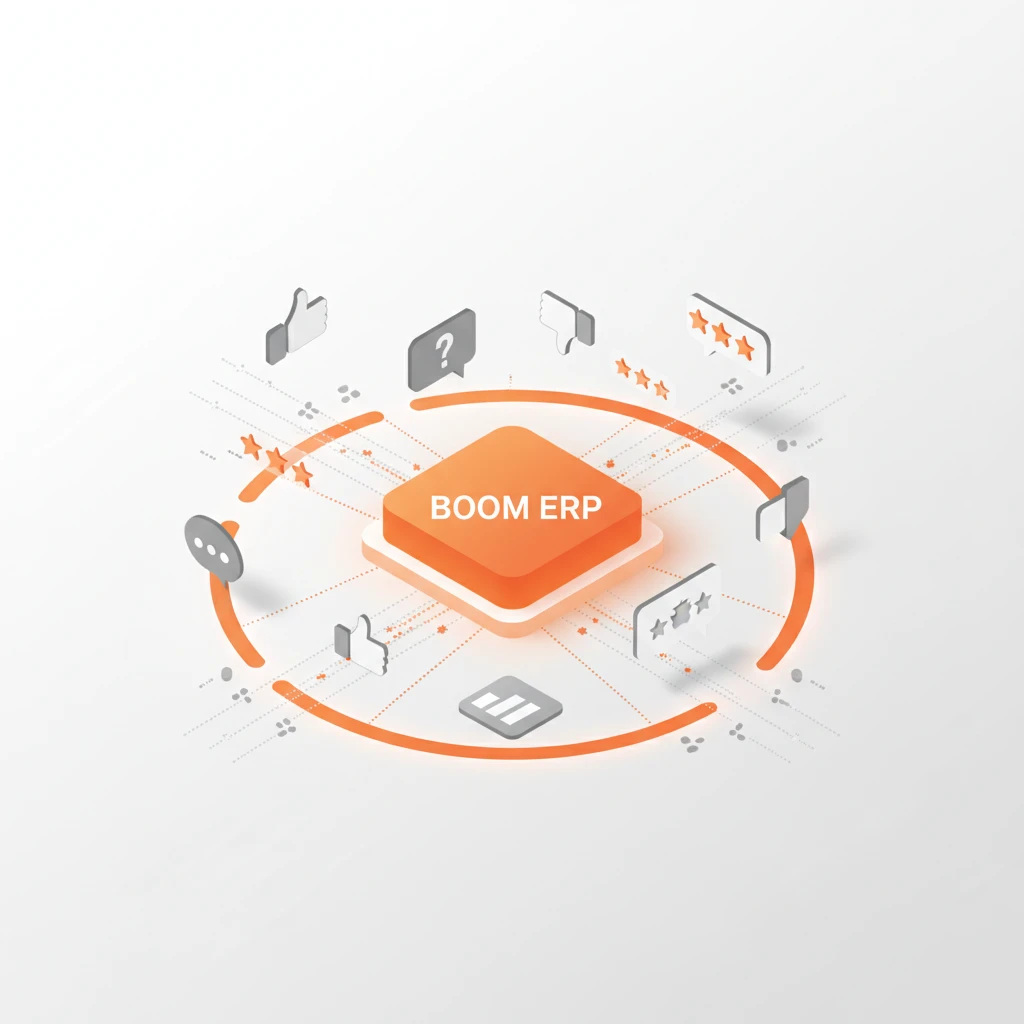
Integrated ERP surveys in 2026 improve service agility by collecting customer feedback from the same system that runs your service. Using ERP feedback loops, businesses email surveys to customer groups, leads or staff, and can ask a client to rate a specific appointment. Consequently, they can adjust operations, refine service delivery and resolve bottlenecks sooner. This supports high satisfaction through data-driven adjustments rather than occasional manual reviews. Modern platforms like BOOM ERP simplify this process significantly.
How do ERP feedback loops drive operational agility 2026?
Operational agility 2026 relies on the speed of information flow between customers and decision-makers. When you implement ERP feedback loops, you eliminate the delay between a customer interaction and a management response. For instance, after an appointment your team can request feedback from the client and see the rating on that appointment. Therefore, teams can address issues before they escalate into larger systemic failures. Furthermore, this connectivity ensures that every department stays aligned with current market expectations.
Why is real-time survey analytics essential for modern CEOs?
CEOs today require real-time survey analytics to maintain a competitive edge in a fast-paced economy. Traditional quarterly reviews are no longer sufficient to guide a growing enterprise. Instead, leaders review survey results, with response counts and percentage bars, whenever they need them. This visibility allows for rapid resource reallocation to high-impact areas. By using BOOM ERP, executives can see exactly where their service delivery excels or falters without digging through separate spreadsheets.
How does client feedback impact project management?
Bringing client feedback into project management changes how teams execute tasks. Specifically, clients follow progress in the client portal and comment on tasks as the work moves, so project managers hear concerns during the project rather than at the end. If a phase is not going well, the team can adjust its approach immediately. Consequently, this reduces the risk of rejection at the final delivery stage. Moreover, it fosters a culture of transparency and proactive communication between the service provider and the client.
Can fast follow-up reduce churn in 2026?
Yes, fast follow-up is highly effective at reducing client churn in 2026. It acts as a safety net for your business relationships. For example, when an appointment is rated poorly or a survey shows dissatisfaction, your team can book a follow-up appointment in the same chain and log calls with follow-up reminders that repeat until they are done. This rapid intervention shows the customer that their voice is heard and valued. Hence, companies that follow up consistently tend to keep more of their clients than those relying on occasional outreach.
How are you improving service delivery with ERP surveys?
Improving service delivery with ERP surveys involves more than just asking questions; it requires action. By embedding surveys into the lead-to-cash workflow, you capture insights at the moment of highest relevance. Your team then uses these insights to refine future service. Notably, this creates a continuous improvement cycle that evolves with your customer needs. 
What are the benefits of data-driven customer experience management 2026?
Data-driven customer experience management 2026 focuses on removing guesswork from the service equation. When decisions are based on hard data from ERP feedback loops, the results are more predictable. This approach leads to more efficient staffing, better product-market fit, and higher profitability. Furthermore, it empowers employees by providing them with clear evidence of what customers actually want. In short, data transforms customer experience from a subjective goal into a measurable business metric.
Why should you focus on integrating feedback into operational workflows?
Integrating feedback into operational workflows ensures that customer insights do not sit idle in a marketing database. Instead, they become actionable tasks for your operations team. When a client suggests an improvement, your team can turn it into a task in the next project cycle. This level of integration is a core strength of BOOM ERP. By centralizing these functions, you avoid the fragmentation that often plagues businesses using disconnected software apps.
What makes BOOM ERP different for feedback management?
BOOM ERP offers a unified ecosystem that replaces multiple disconnected applications. It provides an end-to-end workflow where feedback is naturally woven into the lifecycle of every client. On the Business and Enterprise plans, the system runs on your own domain, so you keep your brand identity while using its survey tools. Additionally, it offers role-based security to ensure that sensitive customer data is only accessible to authorized personnel. This comprehensive approach makes it the ideal choice for teams of any size.
How to start with ERP feedback loops today?
Starting with ERP feedback loops is straightforward when you have the right infrastructure in place. First, identify the key touchpoints in your customer journey where feedback is most valuable. Second, design short, impactful surveys that target those specific moments. Third, choose the audience and send the survey by email or share its public link. Finally, monitor the results and adjust your operational strategies based on the trends you observe. To help you get started, follow these steps:
- Define clear objectives for each survey within your ERP.
- Send surveys to customer groups after key milestones or delivery periods.
- Request feedback on individual appointments to catch problems early.
- Review survey percentages and free-text answers during monthly strategy meetings.
- Keep questions short, mark only essential ones as required, and reorder them for a natural flow.
- Train your staff on how to interpret and act on real-time survey analytics.
Frequently Asked Questions
What are the primary benefits of ERP feedback loops in 2026?
The primary benefits include faster response times to customer issues and improved service accuracy. They also provide valuable data for long-term strategic planning and resource management.
How does BOOM ERP handle survey data?
Survey responses are stored anonymously, keeping only the IP address, browser and date, and each survey has its own results page with response counts, percentage bars and every free-text answer. Appointment feedback, by contrast, is kept on the appointment itself.
Is collecting customer feedback difficult to set up?
No. With a unified system like BOOM ERP, you build a survey from checkbox, radio, input and free-text questions in minutes, then send it to customers, leads by status, staff or an imported mail list.
Can I try these features for free?
Yes, BOOM ERP offers a 7-day free trial with no credit card required. This allows you to explore all the features including the survey tools.
Does the system scale for large operations?
Absolutely, the system is designed to scale for any team size. It maintains high performance even as your volume of feedback and operational data grows.
Why is operational agility 2026 more important now?
Markets move faster than ever, and customer expectations change rapidly. Operational agility 2026 is the only way to remain relevant and profitable in a volatile economy.
Achieving true service excellence requires the right tools and a commitment to listening to your clients. By implementing ERP feedback loops, you can transform your business into a responsive, customer-centric organization. Explore our full range of features to see how we can help you grow. Follow us on Facebook for more updates on operational agility 2026 and start your free trial today.