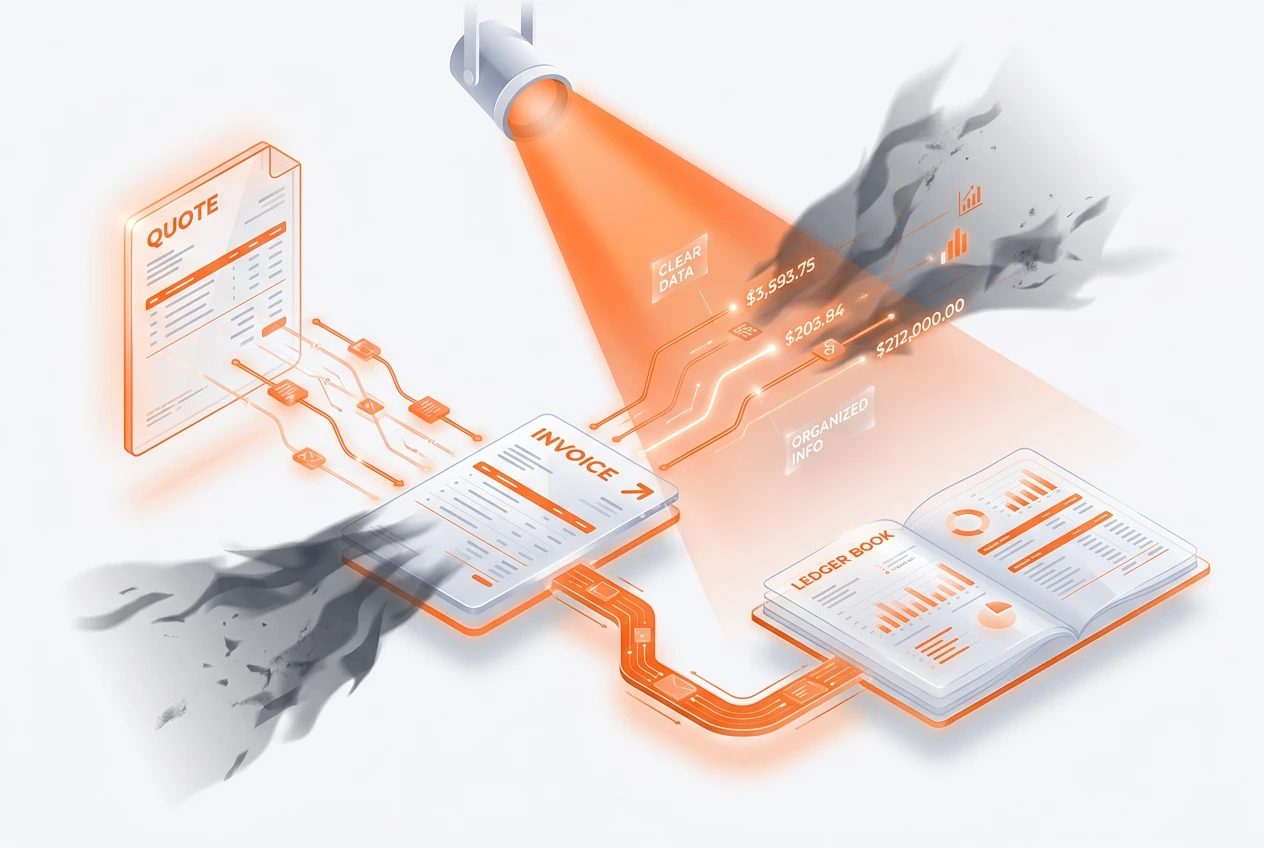
Real-time financial reporting is achieved by using a single platform for your entire quote-to-ledger process. When sales, project, and expense data instantly update your general ledger, you gain immense clarity. For example, when a sale closes or an expense is logged, the transaction automatically reflects on your P&L and balance sheet. Consequently, this approach eliminates manual reconciliation and provides immediate financial clarity, erasing dangerous blind spots.
What Is a Quote-to-Ledger Process?
The quote-to-ledger process covers every financial step from the initial sales quote to the final entry in your general ledger. It connects your sales team’s activities directly to your accounting records. Traditionally, this involves many manual steps and different software tools. However, modern systems unify these stages into one seamless workflow. This integration ensures data consistency and saves countless hours of administrative work.
Why Is Manual Financial Reporting So Risky?
Manual financial reporting creates dangerous delays and introduces human error. When staff must copy data between sales, billing, and accounting systems, mistakes are inevitable. Consequently, these errors can lead to incorrect financial statements and poor business decisions. Furthermore, the time lag means you are always looking at outdated information. This makes it impossible to react quickly to market changes or internal performance issues.
How Does a Unified Platform Improve Cash Flow Visibility?
A unified platform provides a single source of truth for your finances. It allows you to track revenue from the moment a deal closes. Therefore, you can see expected cash inflows much earlier. Additionally, it centralizes expense management, giving you a clear picture of outflows. This complete, real-time view helps you improve cash flow visibility. You can make more accurate forecasts and manage working capital more effectively.
What Are the Core Stages of Accounting Workflow Automation?
Automating your accounting workflow involves several key stages. It begins with integrating your CRM with your accounting software. This ensures sales data flows automatically. Next, it includes automated invoicing and payment processing. Finally, it ends with automated financial statement generation. Each stage replaces a manual task with a reliable, software-driven action. This is central to an efficient quote-to-ledger process.

How Does This Process Impact Revenue Recognition?
An automated quote-to-ledger process transforms revenue recognition. It allows your system to apply complex revenue rules automatically when a sale is recorded. For instance, for subscription services or long-term projects, the software can correctly defer and recognize revenue over time. This ensures compliance with standards like ASC 606 and IFRS 15. Moreover, it eliminates manual calculations and reduces audit risks significantly.
Can a Quote-to-Ledger Process Link Sales Data to Accounting?
Absolutely. The primary goal of a modern quote-to-ledger process is to create a direct link between sales and accounting. When a salesperson marks a deal as ‘won’ in the CRM, the system can instantly generate a corresponding sales order and invoice in the accounting module. This direct connection ensures that revenue figures are always accurate and up-to-date. Therefore, it solves the long-standing challenge of how to link sales data to accounting reliably.
What Are the Benefits of Automated Financial Statement Generation?
Automated financial statement generation delivers speed and accuracy. Instead of waiting weeks for month-end closing, you can produce a P&L, balance sheet, or cash flow statement on demand. These reports are always based on the latest transactional data. Key benefits include:
- Time Savings: Finance teams are freed from manual report building.
- Accuracy: Automation eliminates data entry and formula errors.
- Faster Decisions: Leaders get immediate insights to guide strategy.
- Compliance: Reports are consistently formatted for audits.
- Real-Time Insight: You always know your exact financial position.
How Does BOOM ERP Unify Your Operations?
BOOM ERP replaces your collection of separate apps with a single, unified ecosystem. Our platform manages everything from lead generation to financial reporting in one place. This end-to-end workflow is the foundation of a true quote-to-ledger process. Instead of fighting with integrations, your teams work together on one platform. Notably, BOOM ERP offers role-based security, ensuring staff only see the data relevant to their job. This simplifies complexity and boosts productivity. Explore our powerful features to learn more.
Frequently Asked Questions
What is real-time financial reporting?
Real-time financial reporting is the ability to access up-to-the-minute financial statements and data. It happens when all business transactions, like sales or expenses, instantly update the general ledger without manual intervention.
How does accounting workflow automation work?
Accounting workflow automation uses software to handle repetitive accounting tasks. This includes invoice creation, payment reminders, expense approvals, and report generation, which reduces manual effort and increases efficiency.
Why is revenue recognition software important?
Revenue recognition software is crucial for accurately tracking and reporting revenue according to accounting standards. It automates complex calculations for subscriptions or project milestones, ensuring compliance and saving time.
How can I improve cash flow visibility?
You can improve cash flow visibility by using a unified system that tracks both incoming revenue and outgoing expenses in real time. This gives you a complete and current picture of your cash position at all times.
What is the main benefit of linking sales to accounting?
The main benefit is data accuracy and speed. Linking sales data directly to accounting eliminates manual data entry, reduces errors, and ensures that your financial reports immediately reflect your company’s sales performance.
How does a unified platform like BOOM ERP help?
A unified platform like BOOM ERP eliminates the need for multiple, disconnected applications. It provides a single source of truth for all business data, streamlining workflows from sales to finance and providing complete visibility.
Ultimately, a disjointed financial process creates blind spots that put your business at risk. By implementing a unified quote-to-ledger process with BOOM ERP, you gain the real-time visibility needed to make confident, data-driven decisions. Our system is built to scale with your team and eliminates the complexity of managing multiple tools. Ready to see the full picture? Start your 7-day free trial today, with no credit card required. For more updates, follow us on Facebook!